Stories of Intentional Growth
Insights and stories that help you reflect, choose better, and grow, one step at a time.

أفضل منصات الإرشاد المهني للناطقين بالعربية
أفضل منصات الإرشاد المهني للناطقين بالعربية الإرشاد المهني باللغة العربية ليس سوقاً مزدحماً، بل سوق ينقصه العرض. منصة ADPList هي الخيار المجاني الأقوى بفضل أعداد حقيقية من الموجهين في الإمارات ومصر وا…

Karriere-Mentoring auf Deutsch: Plattformen im Vergleich
Karriere-Mentoring auf Deutsch: die ehrliche Übersicht Wer Karriereberatung auf Deutsch sucht, findet auf den großen int…

Best Career Mentoring Platforms for Arabic Speakers
Best career mentoring platforms for Arabic speakers ADPList is the strongest free option for Arabic speakers, with real …

Best Mentorship Platforms for Students and New Grads
Best mentorship platforms for students and new grads For students and new graduates, ADPList is the best free option wit…

MentorCruise vs GrowthMentor: Which One in 2026?
MentorCruise vs GrowthMentor: the short answer Choose MentorCruise if you want one specific expert in tech, product or d…

ADPList Alternatives: 3 Honest Options for 2026
ADPList alternatives: the three that actually make senseThe best ADPList alternatives in 2026 are Nawaya for career clar…

Best Career Mentoring Platforms for Job Seekers (2026)
Best career mentoring platforms for job seekers in 2026For job seekers, the best career mentoring platform is the one wh…

Career Coach vs Mentor: Which Do You Need?
You've reached a point in your career where you feel the need for guidance. Perhaps you're considering either a career c…

Career Pivot: Change Direction Without Starting Over
You might be feeling stuck in your current role, yearning for something different but not wanting to throw away the year…
Mentoring Side Income: Monetize Your Career Experience
If you're a working professional in Europe, leveraging your career experience as a mentor can be a rewarding side income…

How to Become a Career Mentor and Get Paid
If you’re an experienced professional who enjoys offering career advice, you might wonder if you can turn this passion i…

What Career Is Right for Me? Find Out Now
You're at a crossroads, wondering what career is right for you. Instead of relying on personality quizzes, a structured,…

Feeling Lost in Career: Finding Your Way Forward
Feeling lost in your career is more common than you might think, especially when you find yourself in a role that no lon…

I Hate My Job. What Should I Do Now?
Feeling frustrated and stuck at work is a common yet distressing experience. If you're thinking "I hate my job, what sho…
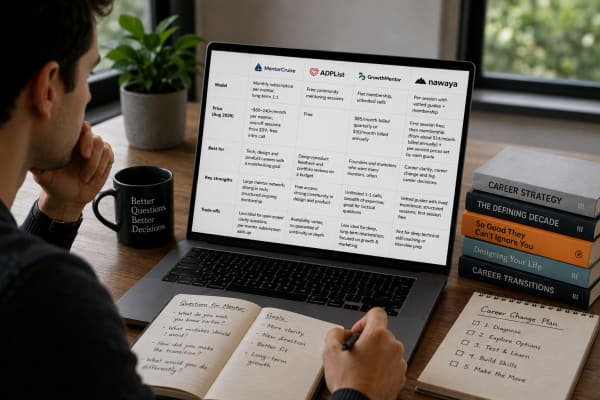
Best Career Mentoring Platforms in 2026, Compared
Searching for a mentoring platform lands you in a swamp of ten-item listicles written by people who never used any of th…

MentorCruise Alternatives: 3 Honest Options for 2026
MentorCruise is a good platform; let's start there. With 7,000+ mentors and a proven long-term mentorship model, it has …

What Is a Career Mentor, and Do You Need One?
Everyone tells you to "get a mentor" the way they tell you to drink more water, as if it were obvious what that means, w…
Career Change at 30: What to Know First
Thirty is the age where a career change starts to feel expensive. You have five to eight years invested in your field, a…

How to Change Careers, Step by Step
Most career-change advice fails in one of two directions: it either romanticizes the leap ("just follow your passion") o…

Career Change at 40: A Realistic Guide
Changing careers at 40 sounds reckless when you say it out loud; there is a mortgage, maybe a family, and a professional…

Feeling Stuck in Your Career at 30? A Practical Reset Plan
Reaching your late 20s or early 30s, you might find yourself feeling stuck in your career. This period, often termed a '…

The Career Audit: A 60-Minute Exercise for Clarity
Sometimes work feels like a routine you are stuck in rather than a path you are progressing on. Whether you have been in…

Why 'Follow Your Passion' Is Misleading Career Advice
You've likely heard the advice to 'follow your passion' when considering your career path. But what if you don't have a …

Signs You've Outgrown Your Job and What to Do Next
You may find yourself feeling restless at work, unsure whether it's just a phase or a sign you've truly outgrown your jo…
Values-Based Career Decisions: A Practical Guide
You're at a career crossroads, contemplating your next move. Perhaps you're eyeing a promotion, considering a job change…

Career Clarity: How to Find Direction When You're Stuck
Feeling stuck in your career is unsettling, especially when you cannot name what is actually wrong. You might be questio…

Entrepreneurs Have a Systems Problem, Not Motivation
I’ve lost count of how many conversations start the same way: “I just need to get more consistent.” It usually comes wit…
Community-Led Growth: Scaling PageSpeed Matters
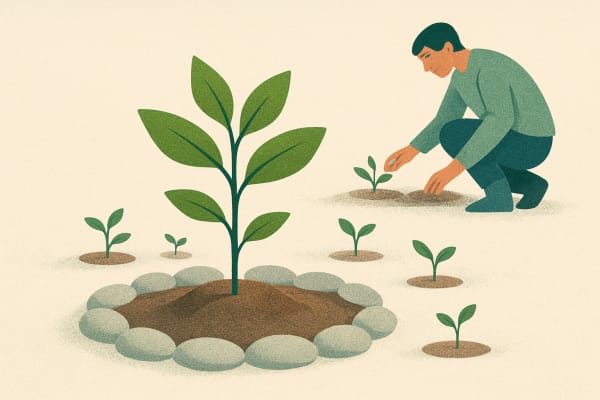
I started PageSpeed Matters six years ago with one engineer and a single WooCommerce client whose checkout was loading i…

The Intern Who Taught Me More Than Any MBA Could
In 2018, my entire company was a desk in my sister's office in Tangier. One monitor, a WiFi connection that dropped twic…

Building a Values-Based Employer Brand on a Budget
Cultural fit has become an essential factor in the job search. Job candidates are increasingly looking for jobs that are…

Building Stronger Communities Through Better Engineering
Communities are shaped by the spaces people live in and the infrastructure they rely on. At ABL Consultants Pte Ltd, we …

Mentoring vs Coaching: The Real Difference
Should you work with a coach or find a mentor? If you want to grow faster, in your career, your business, or your life, …

How to Step Outside Your Comfort Zone Without Burning Out
Why stepping out so often ends in burnout Growth does happen outside your comfort zone, and so does burnout. For the fir…

Why Most Self-Improvement Advice Fails (And What Actually Works)
IntroductionSelf-improvement has become a global industry.Every day millions of people watch motivational videos, listen…

7 Daily Habits That Transform Personal Development
Why ambitious habit plans collapse by February Daily habits work when they survive a bad week, which is why small and bo…

The Personal Growth Journey: Why Change Takes Time
How long personal growth actually takes Real personal growth takes longer than the thirty day promises suggest, because …

Conscious Breathing: The Ultimate Keystone Habit
The Habit We Overlook the MostWe chase, or we wish to build better habits relentlessly, like waking earlier, exercising …

Why the Adults Around Us Matter More Than the Programs We Join
It Is Not the Program. It Is the People.Here's something researchers have figured out after decades of studying what hel…

In the Age of AI Choosing a University Has Never Been Easier or Harder
A New Reality for Student Decision MakingFor today’s students choosing a university is no longer a matter of flipping th…

Preserving Human Connection in a Tech-Driven World
The Modern DisconnectThere is a Modern Disconnect in an age where we grew up hearing stories of our grandparents’ physic…
Small Steps, Real Change: Why Transformation Is Rarely Instant
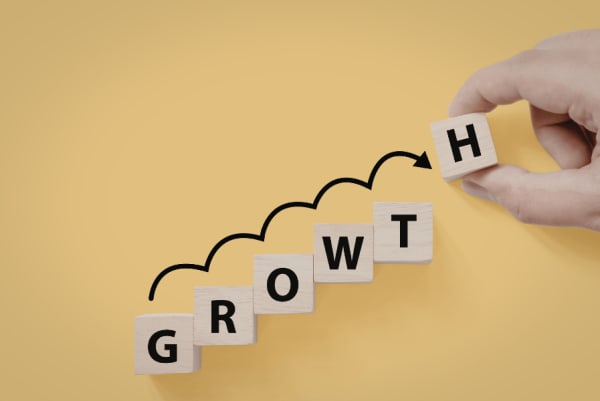
Why transformation is almost never instant Transformation stories get told as single moments because moments are easier …

Choosing Your Path: How to Design Growth That Fits Your Life
Why generic growth plans fail Most growth plans fail not because the advice is wrong but because it ignores your actual …

Community as a Growth Multiplier: Why We Grow Better Together
Why growth feels harder alone Growth is framed as a solo project and rarely is one. Community does not replace individua…

Why Learning Alone Is Not Enough: The Power of Guided Growth
The gap between knowing and growing You can learn endlessly and still feel stuck, because knowledge creates awareness wh…

How Reflection Accelerates Growth Without Hustle or Burnout
Why reflection is not the opposite of action Reflection looks passive and is not. A short regular review does not replac…

The Difference Between Motivation and Intentional Action
Motivation versus intentional action Motivation is a feeling, intentional action is a decision. Motivation fades and pro…

From Noise to Clarity: How to Stop Consuming and Start Growing
Why more information makes you feel worse More input is not the answer when you already feel overwhelmed. Clarity comes …

Growth Isn’t Linear: Why Setbacks Are Part of Real Progress
Why progress comes in waves Growth stories are told in straight lines, but real progress moves in waves, with long flat …

What Does Intentional Living Really Mean in a Distracted World?
What intentional living actually means Intentional living means deciding what deserves your attention before the day dec…

The Age of Intentional Growth: Why Clarity Matters More Than Speed
Why clarity beats speed Everything around us rewards moving faster, yet many people feel stuck precisely because they ar…